Premiere Pro Synchronize not working: causes and fixes
In Premiere Pro, Synchronize is most often greyed out because of what is selected. The usual fix is one clip per track, with at least one clip that has audio. Sometimes Synchronize runs and says a match could not be found. Then the clips usually do not share clear enough sound.
Below is a table of symptoms, causes and fixes. Then come the steps for one camera and for several. Facts about Premiere come from Adobe's help. Tips from Adobe's community forum are marked as common advice. The last part is for shoots with dozens of clips.
Symptoms, causes and fixes
| Symptom | Why | What to do |
|---|---|---|
| Clip > Synchronize is greyed out | Common advice: the selection has two clips on one track, or no clip with audio. | Select one clip per track. Include the recorder file or another clip with sound. |
| The Clip Marker option is greyed out | Adobe's help: it stays disabled until every clip has at least one numbered marker. | Add a numbered clip marker at the same moment in every clip, for example the clap. |
| Merge Clips is greyed out or will not merge | Adobe's help: a merged clip can have only one video clip, and a merged clip cannot be merged again. | Select one video clip and its audio. Use the original clips, not a merged one. |
| Clips merged in the Timeline are out of sync | Adobe's help: clips merged in the Timeline line up from Clip Start. | Run Clip > Synchronize first, then merge. |
| “Could not synchronize one or more clips in the current selection because a match could not be found” | Common advice: the clips do not share clear enough sound, or one track is much quieter than the other. | Raise the gain of the quiet track. Render the audio first (Sequence > Render Audio). Or trim both clips to a stretch where both hear the same sound, such as the clap. |
| The multicam sequence leaves clips out | Adobe's help: without Create Single Multicam Source Sequence, only overlapping clips are combined. Clips with no overlaps are left unused. | Tick Create Single Multicam Source Sequence. |
| Clips from one camera land on different tracks | Adobe's help: clips with matching Camera Label or Camera Angle are placed on their own track. | Give every clip from one camera the same Camera Label before you sync. |
| Sync by timecode puts clips in the wrong place | Adobe's help: timecode must be identical on all clips. | Sync by audio instead. Or set the timecode in Clip > Modify > Timecode. |
The rows marked Adobe's help come from these pages: Synchronize, Merge Clips, merging in the Timeline, merged clip limits, multi-camera source sequences and marking clips for sync. Common advice comes from Adobe's community forum.
Sync by sound in Premiere, step by step
One camera and a recorder. This is the most common case. Use Synchronize in the Timeline.
- Put the camera clip and the recorder file in a sequence, one clip per track.
- Select both clips and choose Clip > Synchronize.
- As the point of synchronization, choose Audio track channel, and pick the channel to match by.
- Click OK. If Premiere reports no match, check the table above.
- Want one merged clip? Synchronize first, then choose Clip > Merge Clips.
Several cameras and a recorder. Use a multi-camera source sequence.
- Give every clip from one camera the same Camera Label. Do the same for each recorder.
- In the Project panel, select all camera clips and recorder files.
- Choose Clip > Create Multi-Camera Source Sequence.
- Choose Audio as the sync point.
- If the cameras stopped and started during the shoot, tick Create Single Multicam Source Sequence.
- Click OK, then play the sequence through before you cut.
When the sound will not match. Mark the sync point by hand. Adobe's help suggests an In point where the slate claps. A clip marker on a clear cue works too, such as a cymbal crash or a camera flash. Then sync by Clip Start (called In Points in a multi-camera source sequence) or by Clip Marker.
When there are dozens of clips
Everything above works on a selection you prepare. Each camera needs a label, each track one clip, and each result a check. With a few clips that is quick. With dozens of files from several cameras and recorders, the preparation grows with every file.
With CamHeard there are no labels to set and no selection to build. It is an app for macOS and Windows that syncs cameras and recorders by sound. Premiere Pro gets a ready sequence.
- Copy the shoot as usual: one folder for the shoot, with a folder for each camera and each recorder inside.
- Drag the shoot folder onto the CamHeard window and press Sync.
- Choose Export, then Premiere Pro, and save
CamHeard_sync.xml. - In Premiere, choose File > Import… and pick that file, or drag it into the Project panel. A sequence with the same name appears.
Better not to mix files from different cameras or recorders in one folder. With a folder per device, devices that were recording at the same time land on separate tracks.
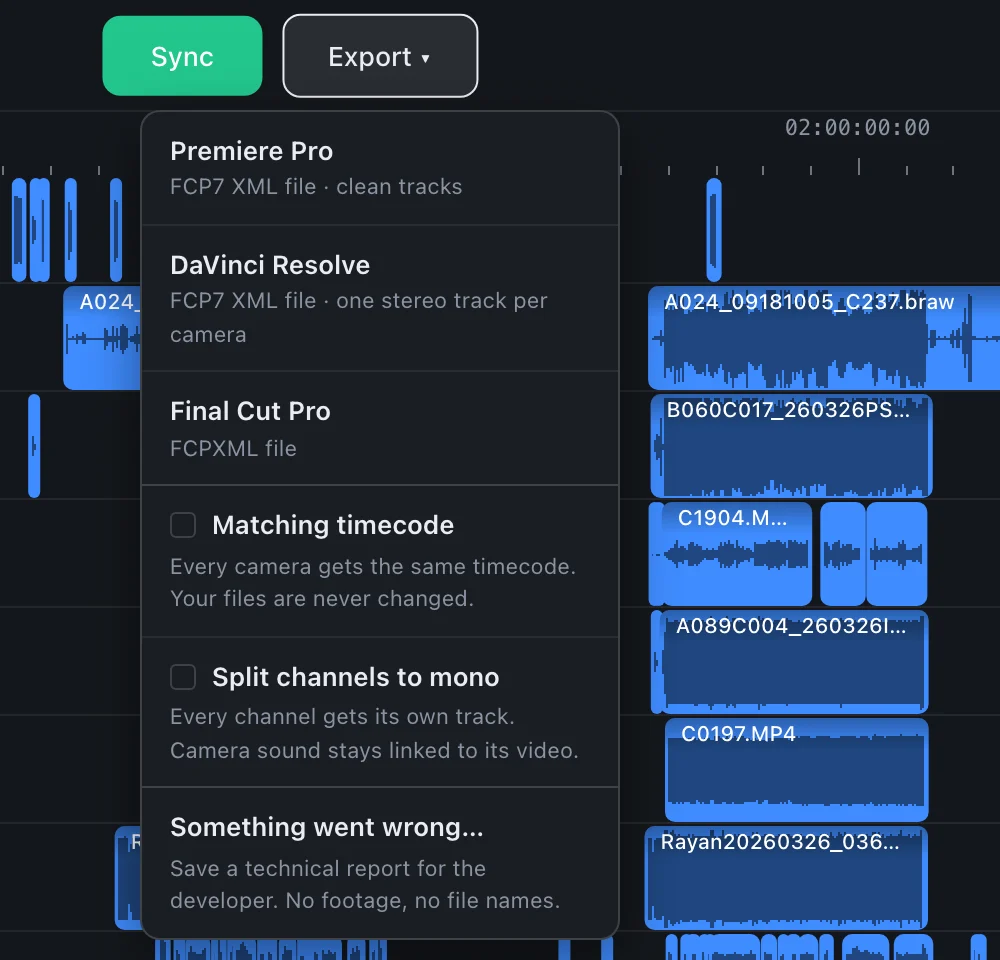
The Export menu. Premiere Pro gets an FCP7 XML file with clean tracks.
In the sequence, cameras that were recording at the same time get separate video tracks, each with its sound on the audio track next to it. The recorder sits below. Multichannel files arrive as separate mono tracks.
By default, clips that had nothing to sync with sit at the end of the sequence, labelled yellow. No file is lost. After the export, CamHeard reports how many media files are in place and warns if some have moved.
Adobe's help asks for identical timecode on every clip for a timecode sync. Tick Matching timecode in the Export menu, and CamHeard writes a shared timecode for every camera into the exported file. That is what a timecode sync in Premiere needs. Your files on disk are not changed.
One real shoot: 215 files from eight cameras and a recorder. CamHeard 0.4.35 synced it in about a minute on a MacBook Pro with M3 Max. The more you shot, the longer it takes.
CamHeard runs on macOS 15 or later with Apple silicon, and on Windows 10 or 11, 64-bit. The first 14 days are the full app, with no card and no account. After that, projects up to 20 clips stay free. A licence costs $15 a month, $144 a year or $249 for life.
Frequently asked questions
- Why is Synchronize greyed out in Premiere Pro?
- Most often it is the selection. The common advice on Adobe's forum is one clip per track, with at least one clip that has audio. The Clip Marker option has its own rule: Adobe's help says it stays disabled until every clip has a numbered marker.
- Why does Premiere say it could not synchronize one or more clips?
- Premiere found no match in the sound of the selected clips. Common fixes from Adobe's forum: raise the gain of the quiet track, render the audio first, or trim both clips to a stretch with the same sound. If that fails, set an In point on the clap in each clip and sync by Clip Start.
- Why is Merge Clips greyed out or not working?
- Check the selection against Adobe's limits. A merged clip can have only one video clip, and a merged clip cannot be merged again. In the Timeline, merged clips line up from Clip Start, so run Clip > Synchronize before you merge.
- How do I synchronize multiple clips in Premiere Pro at once?
- For several cameras, select the clips in the Project panel and choose Clip > Create Multi-Camera Source Sequence, with Audio as the sync point. Give each camera its own Camera Label first. With dozens of files, you can drop the whole shoot folder into CamHeard: it syncs by sound and gives Premiere a ready sequence.
- Why are some clips missing from my multicam sequence?
- Without Create Single Multicam Source Sequence, Premiere combines only overlapping clips. Adobe's help says clips with no overlaps are left unused. Tick that box when the cameras stopped and started.
Try it on your last shoot. Your own footage is the most honest test. The first 14 days are the full app, no card, no account.
Download CamHeard freemacOS 15+ · Apple silicon | Windows 10/11 64-bit