Running the sync
Press Sync. After that you can do nothing: the app listens to the footage and lays it out on the timeline by itself.

What you see while it runs
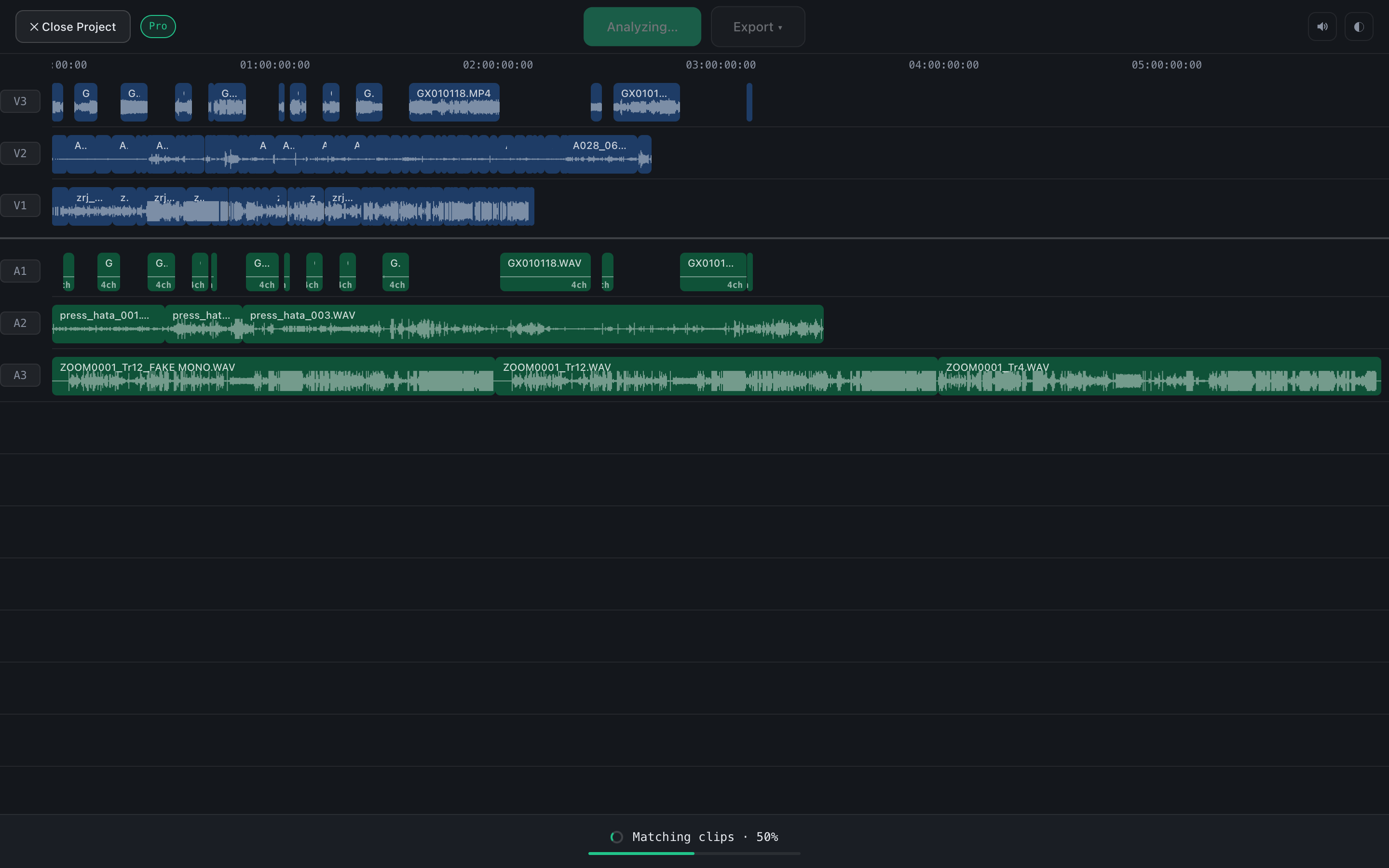
The button changes to Analyzing…, and at the bottom the stage and the percentage run, for example Decoding audio · 26%. There are several stages; the two longest are:
- Decoding audio: reading the sound out of every file. Drive speed matters most here.
- Matching clips: the sync itself.
- Then shorter ones: Resolving timeline, Locking recorder tracks, Checking our own work, Refining frame accuracy.
How long it takes
The more footage, the longer. Drive speed and the computer itself matter most. As a guide, on a Mac with Apple Silicon and footage on a fast drive:
| Shoot | Footage | Sync |
|---|---|---|
| 1 camera + recorder, 12 files | 36 min | 2.6 s |
| 3 cameras + recorders, 117 files | 2.8 h | 15 s |
| 5 cameras + recorder, 209 files | 10.1 h | 30 s |
| 8 cameras + recorder, 215 files | 8.9 h | 29 s |
| 3 cameras + 3 recorders, 241 files | 17.3 h | 1 min 2 s |
| 6 cameras + 3 recorders, 307 files | 15.0 h | 1 min 5 s |
These are real shoots, and their screenshots are on the Shoot examples page. On a slow drive or a network volume the same shoots take several times longer.
When it is done
The clips move to their places, a short sound plays (you can turn it off with the speaker in the top bar) and the numbers appear in the status bar. What they mean is described on the Status bar page.
If some cameras have gaps where other cameras were rolling, the message Possible missing cards: 2 gap(s) other cameras cover appears. See Possible missing card.
If the sync did not finish
A red banner appears, The sync didn’t finish, with the error text. What to do next is described on the Troubleshooting page.